Frontline Vigor
Built for real life, not perfect schedules

Stronger for your shift.
Healthier for life.

Practical, evidence-informed fitness and wellness education for first responders, healthcare professionals, shift workers, and anyone ready to move forward.

Free education. Flexible workouts. Wellness that fits real life.

Frontline Vigor FV monogram

FV15

15-minute workouts, built around your day.
Practical wellness. Real-life schedules.
How it works

Your schedule changes. Your wellness shouldn't suffer.

Take one practical step at a time. Start with what you can do today and build consistency over time.

Choose 15 minutes

Find time-efficient exercise sessions for busy days, at home or in the gym.

Move at your level

Choose beginner or intermediate workouts and adjust to your energy.

Learn for free

Read The Frontline Vigor Brief for free on this website. Download each PDF—no email address required.

Our mission

Wellness should be accessible to everyone.

Frontline Vigor is being developed to share useful health and wellness education with those who serve others. The Frontline Vigor Brief and basic educational resources will remain free, with no email signup.

Start small. Build momentum.

Fifteen-minute workouts can be a useful starting point. They don't replace recommended weekly activity levels or individualized medical guidance. Consistency, appropriate intensity, and gradual progression matter.

Free for everyone, forever

Free Wellness Resources

Practical wellness information for demanding schedules, plus the free Frontline Vigor Brief PDF publication.

FREE PUBLICATION • NO SIGNUP REQUIRED

Read The Frontline Vigor Brief.

Our free PDF wellness publication explores science-based fitness, recovery, nutrition, and everyday health strategies. Read it online or save a copy for later—no subscriber list, login, or email address needed.

New issues will be added to the publication archive as they are released.

What you'll learn

Four pillars of lasting wellness.

Cardiovascular health Why regular movement helps and how short sessions add up.
Strength & mobility Practical ways to build strength gradually.
Sleep & recovery Understanding fatigue and recovery around shift work.
Everyday nutrition Simple meal and hydration habits for demanding shifts.
Free wellness education

Start with one useful step

Movement

Short sessions count

Short bouts of activity can add up. Adults generally aim for at least 150 minutes of moderate-intensity aerobic activity each week, plus strength work on two days. Easy-paced movement is beneficial, but does not automatically count as moderate-intensity activity.

Recovery

Recovery is part of training

After disrupted sleep or demanding shifts, adjusting workout intensity may be more appropriate than forcing a maximal session.

Strength

Build gradually

A manageable resistance-training routine can build confidence and improve strength over time, especially for beginners.

General wellness education only. No diagnoses, individualized treatment, or medical advice.

Trusted sources

Built on widely accepted activity guidance.

Public recommendations encourage adults to move more, aiming for at least 150 minutes of moderate aerobic activity per week and muscle-strengthening work on two days. Short bouts of activity count. Individual needs and medical situations vary.

These links explain general population guidance; they do not establish the safety of any individual exercise plan.

Free PDF publication • Fitness • Wellness • Recovery

The Frontline Vigor Brief

Practical, evidence-informed wellness for first responders, healthcare professionals, shift workers, and everyone who wants to feel better. Free to read, free to save—no signup needed.

Featured edition

Why 15 Minutes of Physical Activity Can Make a Difference

Discover why short movement sessions matter, explore adult physical-activity guidelines, and try a realistic three-day, 15-minute walking challenge.

Wellness Spotlight Fitness in Action One Small Change
Download PDF ↓

Read the complete issue here as accessible text, or download the original six-page illustrated PDF.

This publication contains general information, not personalized medical advice.

Cover preview of The Frontline Vigor Brief, Issue 1, about the benefits of 15 minutes of physical activity

Cover preview • Issue #1

The publication archive

Explore every edition

Each issue stays freely available here, so you can revisit practical fitness and wellness information whenever you like.

01

November 2026 • 6 pages

Why 15 Minutes of Physical Activity Can Make a Difference

Physical activity guidance and an approachable walking challenge.

More editions will appear here as they are published. No email list or account is required.

Read Issue #1 on this website
The Frontline Vigor Brief • Issue #1 • November 2026

Read The Frontline Vigor Brief — Issue #1

Complete six-page issue, adapted into readable website text. The original illustrated layout is available in the PDF.

PAGE 1 OF 6 • YOUR TIME. YOUR GOALS. YOUR FITNESS.

Why 15 Minutes of Physical Activity Can Make a Difference

Between long shifts, family responsibilities, unpredictable schedules, and everyday stress, finding time to exercise can feel impossible. But here's something encouraging: You don't need an hour at the gym to start improving your health.

According to the Centers for Disease Control and Prevention (CDC), some physical activity is better than none. Even short sessions of movement can contribute toward your weekly activity goals.

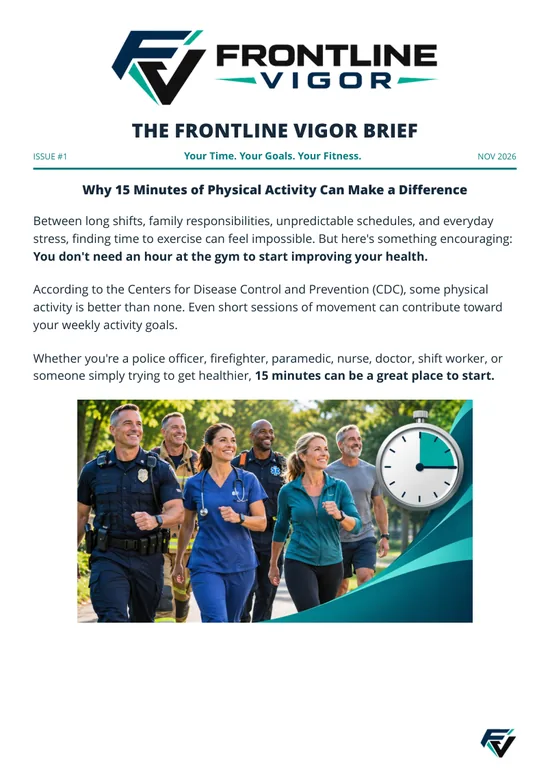
Whether you're a police officer, firefighter, paramedic, nurse, doctor, shift worker, or someone simply trying to get healthier, 15 minutes can be a great place to start.

PAGE 2 OF 6 • WELLNESS SPOTLIGHT

What Does the Science Say?

Physical activity is one of the most effective ways to improve overall health and well-being. But here's something many people don't realize: You don't need to exercise for an hour at a time to experience benefits.

According to the CDC, even a single session of moderate-to-vigorous physical activity can provide immediate benefits, including reduced feelings of anxiety and lower blood pressure.

Regular physical activity can also:

  • Improve cardiovascular health.
  • Support brain health and mental well-being.
  • Improve sleep quality.
  • Strengthen muscles and bones.
  • Reduce the risk of several chronic diseases.

How much exercise do you need?

The CDC recommends that adults aim for:

  • 150 minutes of moderate-intensity aerobic activity per week, or 75 minutes of vigorous activity, or an equivalent combination.
  • 2 days of muscle-strengthening activity each week.

These are goals to work toward, not requirements you must meet immediately.

The takeaway

Short exercise sessions count toward your weekly activity goals when performed at sufficient intensity. Even lighter movement has value, especially when replacing sedentary time.

For busy first responders, healthcare professionals, and shift workers, 15 minutes can be an excellent starting point toward a healthier lifestyle.

Start where you are. Build gradually. Stay consistent.

PAGE 3 OF 6 • FITNESS IN ACTION

Your 15-Minute Movement Challenge

No gym? No problem!

You don't need an expensive gym membership or specialized equipment to begin improving your cardiovascular fitness. Walking is one of the simplest and most accessible ways to become more physically active.

Your 15-minute walking workout

Minutes 0–3: Warm up

Begin walking at a comfortable, easy pace. Allow your muscles and cardiovascular system to gradually adjust to the activity.

Minutes 3–13: Pick up the pace

Increase to a brisk walk. Aim for a pace that raises your heart rate and breathing while still allowing you to carry on a conversation. This is called the Talk Test, a practical way to estimate moderate exercise intensity.

Minutes 13–15: Cool down

Gradually slow your walking pace. Allow your breathing and heart rate to return toward their resting levels.

Remember: Progress, not perfection!

If brisk walking is too challenging, slow down. Start at your current fitness level and gradually increase your pace or duration as your endurance improves.

Fifteen minutes today can be the beginning of a healthier tomorrow!

Safety first

Stop exercising if you experience chest discomfort, dizziness, faintness, unusual difficulty breathing, or sharp pain. Seek urgent medical assistance for serious symptoms. In a U.S. emergency, call 911.

PAGE 4 OF 6 • PHYSICAL ACTIVITY GUIDELINES

Physical Activity Guidelines

U.S. adults • Move more. Sit less.

150minutes/week of moderate activity
OR
75minutes/week of vigorous activity
PLUS
2+days/week of muscle-strengthening activity

Examples of moderate activity

  • Brisk walking
  • Bicycling (on level ground)
  • Recreational swimming
  • Dancing
  • Yard work (mowing, raking, etc.)

Examples of vigorous activity

  • Running
  • Swimming laps
  • Fast cycling

Small chunks of activity count toward your weekly aerobic goals.

Even 15-minute sessions add up.

Intensity varies with pace and individual fitness level. A combination of moderate and vigorous aerobic activity also counts toward your weekly goal.

Source: CDC — Adult Activity: An Overview

PAGE 5 OF 6 • ONE SMALL CHANGE

Your 15-Minute Challenge

Small steps. Meaningful progress.

This week, make a commitment to yourself: three 15-minute walking sessions.

That's 45 minutes of planned movement toward a healthier, more active lifestyle.

Start where you are. Build gradually. Stay consistent.

Three practical ways to complete the walking challenge

  1. Day 1: Take a 15-minute walk before or after work.
  2. Day 2: Walk for 15 minutes during a break or after a meal.
  3. Day 3: Invite a friend or family member for a 15-minute walk.

Start at a comfortable pace and build consistency.

PAGE 6 OF 6 • FINAL THOUGHTS AND REFERENCES

Final Thoughts and References

Final thoughts

Getting healthier does not require perfection. It starts with small, consistent steps.

If you are short on time, low on energy, or just getting started, remember this: doing something is better than doing nothing.

A 15-minute walk, a short workout, or simply moving more during the day can help you begin building a healthier lifestyle.

Start where you are. Build gradually. Stay consistent.

Thank you for reading the first edition of The Frontline Vigor Brief.

Contact: [email protected] | © 2026 Frontline Vigor

References

  1. Centers for Disease Control and Prevention. Benefits of Physical Activity.
  2. Centers for Disease Control and Prevention. Adult Activity: An Overview.
  3. Centers for Disease Control and Prevention. How to Measure Physical Activity Intensity.
  4. Centers for Disease Control and Prevention. What Counts as Physical Activity for Adults.

Disclaimer: This publication provides general fitness and wellness information for educational purposes only. It is not a substitute for individualized medical advice. Consult a qualified healthcare professional when appropriate before beginning a new exercise program.

Your Time. Your Goals. Your Fitness.

15-Minute Workouts • Free workout plans

Find your 15-minute workout.

Choose your experience, location, goal, and current energy to explore a sample adult workout. Higher energy never adds strength sets; some cardio sessions allow a slightly brisker conversational pace. Low-energy options remain gentle for either experience level. These general examples are not personalized medical prescriptions.

Tell us about today's workout

Your selections stay on this page. Nothing is sent to a server.

Before your first workout

These example sessions are for adults and provide general education, not personalized medical advice. Exercise carries risks. If you feel ill, have an injury or health concern, or are unsure whether to exercise, seek appropriate professional guidance. Rest may be the better choice.

Stop immediately for chest discomfort, faintness, dizziness, unusual breathing difficulty, or sharp pain. Seek urgent medical assistance for serious symptoms; in an emergency, call 911 (U.S.). If you feel ill, rest instead.

Your acknowledgment is stored as a simple yes/no setting on this device when browser storage is available. No medical history is requested.

Your workout appears here

Read the safety information, choose your options, and select “Find my workout” to see one 15-minute adult exercise example.

Your activity • Saved in this browser

Small steps. Real consistency.

After you finish a workout, choose “Finish workout” and confirm saving to record a completion in this browser. No account or cross-device syncing is available.

Workout progress

0 Total saved workouts
0 This week

Only saved in this browser on this device. Your workout completions do not transfer to a different browser or device, even if you revisit Frontline Vigor there. Clearing this site’s browser data can erase them. We cannot recover them. Cross-device progress syncing may be offered in a future premium version, but is not available on this free site. “Clear saved data” removes local completion records and your safety acknowledgment.

Keep it flexible

The current goal is consistency, not perfection. Gradually build toward recommended weekly physical activity levels at a pace suitable for your health and abilities.

Your information • Free website

Privacy Policy

Frontline Vigor's free website is designed to minimize collection of personal information. This policy describes the free website as it exists today, before any accounts or paid features are added.

Free website • General education

Terms of Use

These terms describe the current free website, wellness articles, sample workouts, and downloadable Frontline Vigor Brief. They do not cover future premium features.

Before you save your workout

Your progress stays in this browser

Your completed workout will be saved only in this browser on this device—not in an online account.

Only select Save if you have completed this workout.

For details, see our .